FIRST GRADE: Inventions

The inspiration and the perspiration. Let's study Thomas Edison. And then invent ourselves.

SECOND GRADE: Toys and Roller Coasters

Let's dissect and reverse engineer them. Let's design and create them. Let's imagine!

THIRD GRADE: Inventors

They say he wrangled lightning and invented bifocals. And that was just before breakfast. We'll start with Benjamin Franklin and move on to Da Vinci...

FOURTH GRADE: The Wright Three

Architecture, ghosts, pentonimoes, geometry, mysterious talismans, invisible men... One novel has them all.

FIFTH GRADE: Weslandia

What if you were in charge of rebuilding civilization from the ground up? Well now you are...

Showing posts with label creativity. Show all posts

Wednesday, May 28, 2014

End of Year LEGO Stop-Motion Movies!


Let's face it, when we have two huge bins of LEGO pieces sitting around and access to some cool stop-motion technology, why would we NOT make some awesome stop-motion movies as part of our end-of-year thematic summaries?

But here's the thing: Each grade level was tasked with creating a stop-motion movie that related to our theme for the year. So 5th grade, for example, had to make their film relate to "encounters" between two civilizations or groups; 4th grade's movies had to center around a piece of architecture, and so on...

First we studied some "best practices" for making stop motion with LEGOs, including considering such factors as positioning, background, lighting, movements, etc. Students learned that making a quality stop motion is MUCH harder than they thought, and requires oodles of patience and concentration. That made it an even more important exercise!

At the link below you can access a folder with all the videos. File names are labelled by student first names. Enjoy!

NOTE: We used the app "LEGO Movie Maker" on the iPads. That app is not available on Android but there are other user-friendly stop-motion apps on the Android market.

https://drive.google.com/folderview?id=0B2urbvFV8qF1c3lBaHNYNHNDR0k&usp=sharing


5th Grade: Interactive Inklewriter Story Links!

Fifth graders spent all year building up an imaginary civilization attribute by attribute, from geography to mythology, from basic crops to language and number systems. There were thousands of possible ways to wrap up their study, but we went with a free online program called Inklewriter that allows students to create interactive, reader-driven stories. Their task was to create an interactive story full of reader options that told the story and details of their civilization indirectly along the way. I think you'll enjoy!

NOTE: Although I guided and consulted students as much as possible, they were responsible for their own editing, grammar-checking and link-testing. With our limited time each week, I chose to focus on the development of their ideas as opposed to the meticulousness of their writing.

Now have fun!


If your child's story does not appear here, then they did not finish in class and were asked to finish as homework and send me the link. It's not too late!

Tuesday, April 8, 2014

Fifth Grade Update: The Rise of Civilizations

Bit by bit throughout the year we've been inventing and developing our own civilizations by taking inspiration from real civilizations throughout history, both real and fictional. 

Most recently we've added two new attributes to our civilizations and both gave the opportunity to also practice our creative thinking skills of FFOE and SCAMPER.

Constellations

After studying constellations and their associated myths and legends from various cultures, students designed their own and then wrote a myth to accompany it. The myth needed to somehow form a piece of the mythology of their civilization and reflect something about their civilization's geography, resources, beliefs, etc.


Fruits

Every classic civilization has it's staple food crop. After watching a clip from the intriguing documentary The Fruit Hunters, we decided to make our staples fruits. We got inspiration from the adaptations of real life rare and exotic fruits and created our own. To call our fruits "exotic" would be a huge understatement!


Next up is the culmination of our civilization project in the form of a dynamic, reader-interactive story using the online site http://www.inklestudios.com/inklewriter/. Watch for those stories to be posted before the end of the year.

Wednesday, April 2, 2014

Third Grade Update: A Cameras Handspring!

By the way, "A Cameras Handspring" is an anagram for "Ciphers and Anagrams!" That will make sense in a minute. :)

Benjamin Franklin's life of unending fascination and intrigue continues to be the launchpad for us to explore many exciting topics. This semester that topic has been ciphers. Franklin himself used ciphers during the Revolutionary War in his work as a spy.

First, we understood that there are two basic TYPES of ciphers: 1) Substitution ciphers, in which the letters of the message are replaced by other letters or symbols and, 2) Transposition ciphers, in which the letters aren't changed, but simply rearranged.

For substitution ciphers we started with the most classic of ciphers, the Caesar cipher, and also learned and used the pigpgen cipher. Students made their own cipher wheels to encipher and decipher messages.

To study and practice transposition ciphers we had a LOT of fun with anagrams. We got inspiration from the book Elvis Lives, a book of funny anagrams like "ASTRONOMER = MOONSTARER" and "SOUTHERN CALIFORNIA = HOT SUN, OR LIFE IN A CAR." Pretty amazing, huh?

We got out the letter tiles and students came up with their own hilarious zingers, such as:

"I'M HYSTERICALLY LAUGHING" = "TYLA HAS MY CHIN, GRILL GLEN!" BY TYLA
"ADRIAN IS NOT A CIPHER" = "TARI CAN RAID IPHONES" ADRIAN
"CONSTIPATED" = "COST TED PAIN!" BY ZOIE W. AND MYKAL
"I'M CRAZY VIKING" = "ANY CIG, MR. KIVIZ?" BY KIERAN
"NITISH AND YOSI" = "SIT IN A DISNY" BY NITISH AND YOSI
"MINECRAFT" = "RUN MATEY!" BY COREY 
"RAT OR COB" = "CAR ROBOT" BY RHEA
"INSPECT, OR..." = "INSPECTOR" BY BALA
"WET GOATS HAVE..." = "WE HAVE TOGAS!" BY SHREEYA
"BAD DAY" = "BAY DAD" BY SUMEDHA
"SHE SAT ON BEES!" = "NO BEETS, ASHES" BY OLIVIA
"ROB, IN HERE!" = "HEROBRINE" BY STEVEN
"RAISINS" = "RAIN, SIS!" BY RHEA
"FORWARD" = "FAR WORD" BY APOORVA
"POINTS" = "IN POTS" BY BALA


Monday, March 31, 2014

Second Grade Update: Life's Ups and Downs

This semester has been all about roller coasters! In our last update post we told about some of the coaster research we'd done and how we'd explored some of the science behind coasters. Now, it was time to put all that knowledge into action and build our own mini-coasters.

Student groups were given miscellaneous supplies, such as wooden dowels, cardboard, paper cups, construction paper and tape and asked to create a roller coaster for a golf ball. There were different levels of challenges, including a basic drop, a hill, a double hill, and a loop.

This was true problem-solving and innovation! Were there lots of dead ends? Absolutely! What would be the point if it were all laid out for them? The successes felt so much better because the students had truly earned them.


Wednesday, March 26, 2014

First Grade Update: Detective Work, Tangrams and Brainfocals!

This semester we've been meeting several different characters from the fictional "Crystal Pond Woods." Each of these characters represents a particular type of thinking. The students learn the uses of each type of thinking and practice using it to find solutions to problems and scenarios.

We started with Dudley the Detective, a dog who loves to solve mysteries using logical, or convergent thinking. Dudley inspired us to find solutions that required linear, logical, deductive reasoning. 

Next, we met Max the Magician, a rabbit who is totally passionate about visual/spatial reasoning! He loves puzzles, patterns and visual eye-teasers. After meeting Max we explored tangrams and other geometrical tools for thinking. We even made ourselves little Max the Magician hats. :)


Most recently, we met Isabel the Inventor--she is a master of divergent thinking (generating several possible solutions to a problem). We were introduced to brainstorming as a thinking tool and made our very own "brainfocals"--special glasses that help us see the world from new angles!


Friday, February 7, 2014

Fourth Grade Movie Trailers: They're "Pentominal!"

As you know from last week's status update, our 4th graders have been focusing on the geometrical tool set known as pentominoes. They are a crucial part of the plot in our novel The Wright Three but we are taking them even further. Most recently, students created large, 3-D pentominoes which we've been using to create "rooms" and spaces within the classroom.

Last week, we created movie trailers that revolved around pentominoes in some way. They could be characters themselves or just somehow part of the plot. They are very entertaining. We may have some future filmmakers in our midst. :) Enjoy!


Friday, January 31, 2014

January Update: A Busy Month Culminates in Applied Technology

I found myself with access to a stack of iPads this week and couldn't let the opportunity pass. I quickly updated my plans to incorporate a technology piece that was a perfect extension of the work and explorations we'd been doing at each grade level. Here, then, is a quick summary by grade level of what our January has been all about and then a note about how we used tech this week to enhance and extend our learning.

1st

We've transitioned into visual/spatial reasoning in January, which is a fancy way of saying we've been developing the problem-solving muscles in our brains that utilize visual information to find logical patterns in forms, shapes, colors, etc. We've used two classic geometrical tools to do this: tangrams and pentominoes. This week with the iPads we focused on 3 nice apps to apply these developing skills: Blockaders, Zentomino HD Lite and Zen HD Lite - Relaxing Tangrams. They are all free, find them for your devices!
Tangrams consist of 7 pieces
Pentominoes consist of 12 pieces of 5 sections each

2nd

2014 has been all about roller coasters! We started with some of the basic science, like how coasters get their speed and what "G force" is. Then we went into research mode and dug up some detailed information on famous coasters throughout the world. On the iPads this week, we found the perfect app to begin testing our own coaster engineering skills: Coaster Frenzy. Students have to design, test, and modify their track in order to increase speed and make the ride fun. There is also a wonderful creative aspect to designing a coaster that would be safe AND fun.

3rd

Using Benjamin Franklin's fascination with magic squares as a trigger, we've been playing around with "magic math," especially different types of magic squares. That led us over to a cousin of the magic square, sudoku, and all 3rd graders have now been formally introduced to that classic (and addictive) game. The apps we used this week were ProMagic Square and Sudoku 2. There are probably several thousand sudoku games out there, but this one was a hit for its easy interface.

4th

Well, pentominoes and more pentominoes! As you know, students created 3-D pentominoes at home using 5 6x6x6 inch cubes. We are using those in class for real-life architecture challenges, like the reading nooks we have lovingly called "pentominooks." This week with the iPads we stuck on the theme of pentominoes but with a special creative twist: students used the app iMovie to create movie trailers in which the characters, theme and title all centered around pentominoes in some way. I will share those soon in a separate post.

5th

OK, 5th is the one grade that didn't indulge much in the iPads. We've been busy, though. In January we kicked off a long-term unit on Mindset--a way of framing and perceiving the world and yourself for long-term success and growth. At the same time, we are continuing with our civilization projects. Most recently, students designed (with elaborate detail) the fictional fruits that are the basis of their civilizations. We got some inspiration for our fruit creations from a documentary called Fruit Hunters. We only saw the trailer in class, but Mr. Koch has seen the whole thing and recommends it (Netflix)! :)


Monday, November 4, 2013

2nd Grade Update: There's a SPRING in Our Step

You know from our last update post that we'd had the LEGOs out to do some attribute sorting and a creative design challenge. Well, we weren't quite ready to put them away so we constructed a little research unit on the history of LEGO. We used the book LEGO Toys by Kris Hirschmann as well as the video below as our primary sources and created research mindmaps.


We then switched gears and focused on another classic toy--the pull back car. In our first lab, we conducted an experiment to see if the distance we pulled them back had a direct relationship with how far they went. Our hypotheses was yes! As a secondary experiment, we also compared the data between the car running on the table vs. carpet.

The next major questions was: Where is the energy coming from to make these simple toy cars move? There was only one way to find out--we dissected them!


The great discovery of our dissection was a very special machine--the spring! So THAT sent us on another research exploration, this time to gather more information about springs.

And springs are where we currently stand. This will lead us into an exploration of potential vs. kinetic energy and to the creation of a very special Thanksgiving-themed project. Stay tuned! : )


1st Grade Update: From Light Bulbs to Motion Pictures

Since our opening unit on learning styles and multiple intelligences, we've covered LOTS of ground researching Edison and related inventions. 

We started with some traditional research using the text Thomas Edison and the Light Bulb and gathered our data into a class "big book."
One of our major research questions was to discover what material made the best filament inside the light bulb for it to last the longest. Originally, light bulbs used cotton thread for the filament. You can imagine the problem with that. After experimenting with THOUSANDS of different options, the best material Edison found for a long-lasting bulb was bamboo! Today, tungsten is the most favored material for a filament in a traditional light bulb.

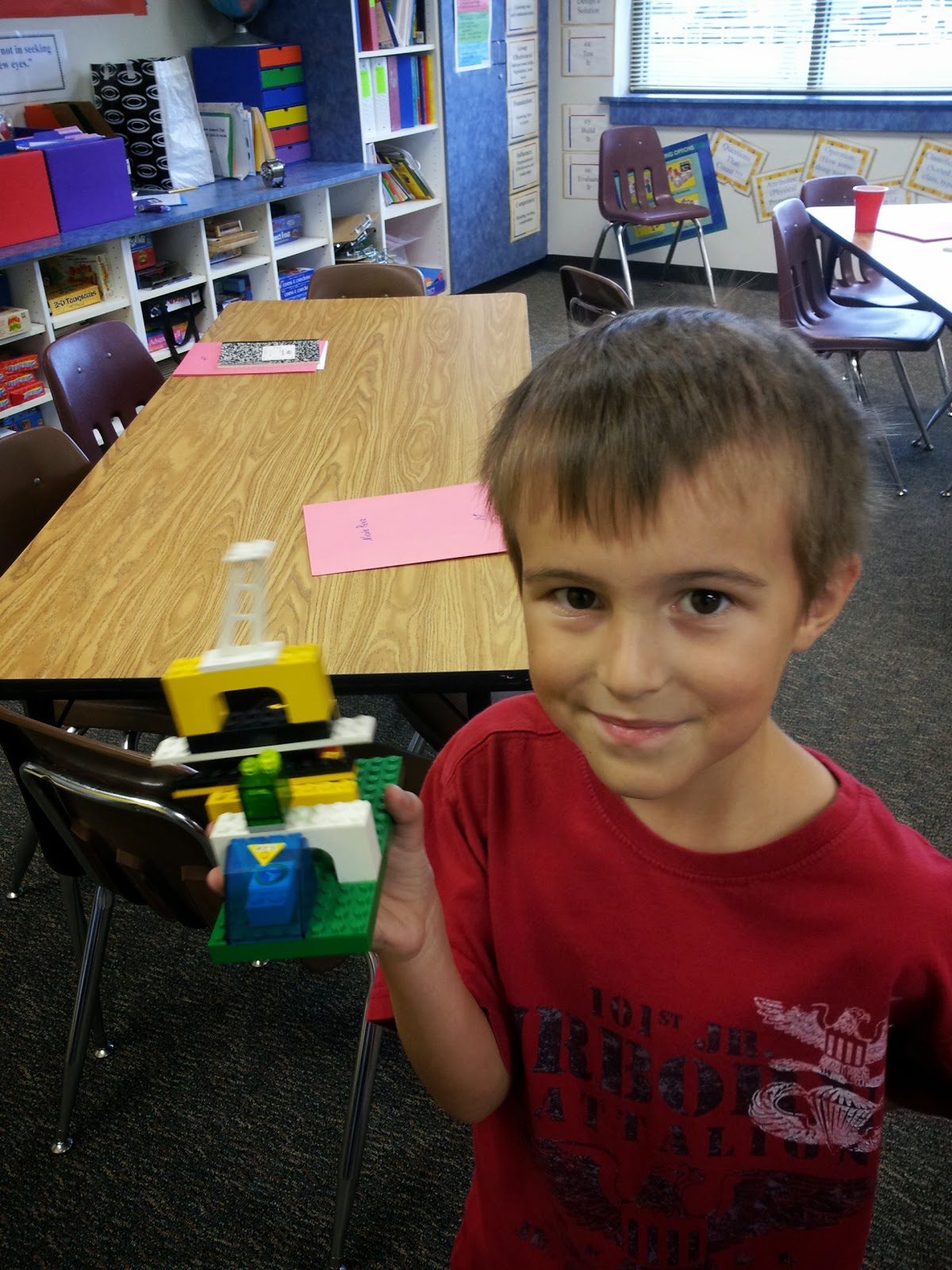
We balanced out the analytical thinking required for our research with a creative challenge: design a light bulb of the future using LEGO pieces!


Next, we applied our growing knowledge of light bulbs by using the classic picture book The Important Book as a model to create our own "important pages" about the light bulb. We also illustrated and diagrammed the major parts of the light bulb to go along with it.


Then it was time to move beyond the light bulb and look at another project that Edison played a role in: the motion picture (AKA the movies!). We discussed the concept of persistence of vision that early animators used to explain how a series of still images could seem to move. Edison was fascinated during his life with one particular, very simple animation device called a thaumatrope. Here's a video with the instructions we used to make our own. The students learned by trial and error which methods worked best and created some very fun, animated scenes! 


Our next step is to take a technological leap but use the same basic methods to create a more complex movie. We'll be using a stop-motion movie maker app on the ipads. Our next update should be some movies for you to watch!


Friday, October 4, 2013

4th Grade Update: The "Wright" Stuff

Other grade levels are enjoying novels as a supplement to their units this year, but 4th grade is the only group using a novel as the primary launch pad for all their explorations. The novel is The Wright Three by Blue Balliet. Here's a book talk/preview:

To set a foundation for reading, we first built up some background knowledge on architecture in general, including some basic concepts and a scavenger hunt of some famous buildings. This included a DI-like design challenge where the students had to create skyscrapers out of very limited materials (tape and two types of paper) in a very limited time. They did quite well!

Since the book centers around the Robie House, a work by Frank Lloyd Wright, we then did some background research on Wright, and each week we are building on that knowledge.

Another huge connection from the novel are pentominoes, a set geometrical and mathematical tools with all kinds of uses. We started with 2-D pentominoes and worked our visual-spatial skills with a number of challenges.


One student designed "Texonimo" in honor of the Lone Star state.

 We've since pulled out some 3-D pentominoes and that opens up a whole new set of challenges!

At the same time, the book itself has made us intrigued with The Invisible Man by H.G. Wells. None of us understand the connection yet, but it keeps popping up in the story. This trailer of the old black and white movie sure got our attention, too!


Our most recent challenge that demanded creativity, innovation, cooperation and organization was another design challenge using LEGO bricks. In our "Think Like an Architect" challenge, students were presented with a client (a family of 4) with specific needs in a home. They then had to design the home to meet those needs. We had some wildly innovative samples!


Soon we'll delve into the more technical and mathematical aspects of architecture, but this was a way to understand the creative problem solving with which an architect approaches his or her work.