FIRST GRADE: Inventions

The inspiration and the perspiration. Let's study Thomas Edison. And then invent ourselves.

SECOND GRADE: Toys and Roller Coasters

Let's dissect and reverse engineer them. Let's design and create them. Let's imagine!

THIRD GRADE: Inventors

They say he wrangled lightning and invented bifocals. And that was just before breakfast. We'll start with Benjamin Franklin and move on to Da Vinci...

FOURTH GRADE: The Wright Three

Architecture, ghosts, pentonimoes, geometry, mysterious talismans, invisible men... One novel has them all.

FIFTH GRADE: Weslandia

What if you were in charge of rebuilding civilization from the ground up? Well now you are...

Showing posts with label books. Show all posts

Friday, February 7, 2014

Fourth Grade Movie Trailers: They're "Pentominal!"

As you know from last week's status update, our 4th graders have been focusing on the geometrical tool set known as pentominoes. They are a crucial part of the plot in our novel The Wright Three but we are taking them even further. Most recently, students created large, 3-D pentominoes which we've been using to create "rooms" and spaces within the classroom.

Last week, we created movie trailers that revolved around pentominoes in some way. They could be characters themselves or just somehow part of the plot. They are very entertaining. We may have some future filmmakers in our midst. :) Enjoy!






Wednesday, November 6, 2013

4th Grade Update: Blueprints In Progress

The mysteries of The Wright 3 continue to deepen as our 3 main characters are gradually unraveling the strange but true history of the Robie House in Chicago. Along the way, though, we let the book send us off on related thinking challenges and projects, and one of those projects is to slowly design our own homes. Little by little we've learned some basic concepts of architecture and also focused on the Math that architects use. We've created a basic layout for our homes designed to suit a family of 5, and then drawn a scaled version of the home (1 inch = 5 feet) aiming for a perimeter of about 200 ft. We've also learned about the aesthetics of a "facade" and explored using repeated elements to create a visual pattern that is pleasing to the eye.
Blueprints in progress
Calculating perimeter
Repeating elements to create a pattern on this "facade"

We've also pulled out the 3-D pentominoes in order to follow the thinking of one of our main characters in The Wright 3. We try to model his constructions, but also explore by making our own.


Here's some of the art glass in the Robie House
One of the most beautiful traits of the Robie House are the art glass windows designed by Frank Lloyd Wright himself. When I came across some old "transparency sheets," the perfect project idea came to mind. "Let's make our own art glass windows!" It was also a nice moment to discuss the "ancient classroom technology" of overhead projectors and transparencies. We mimicked Wright's designs but gave them our own unique flair of personality, first on graph paper and then transferred onto the transparencies. They look A LOT better on a sunny day, but the pictures below should give you an idea...


We've also taken time these last few weeks to review/practice our deductive reasoning skills with the help of logic grids. If you've seen our younger grade updates you'll see they've been practicing as well. We never stop doing them--they just get more and more complex!


Monday, November 4, 2013

1st Grade Update: From Light Bulbs to Motion Pictures

Since our opening unit on learning styles and multiple intelligences, we've covered LOTS of ground researching Edison and related inventions. 

We started with some traditional research using the text Thomas Edison and the Light Bulb and gathered our data into a class "big book."
One of our major research questions was to discover what material made the best filament inside the light bulb for it to last the longest. Originally, light bulbs used cotton thread for the filament. You can imagine the problem with that. After experimenting with THOUSANDS of different options, the best material Edison found for a long-lasting bulb was bamboo! Today, tungsten is the most favored material for a filament in a traditional light bulb.

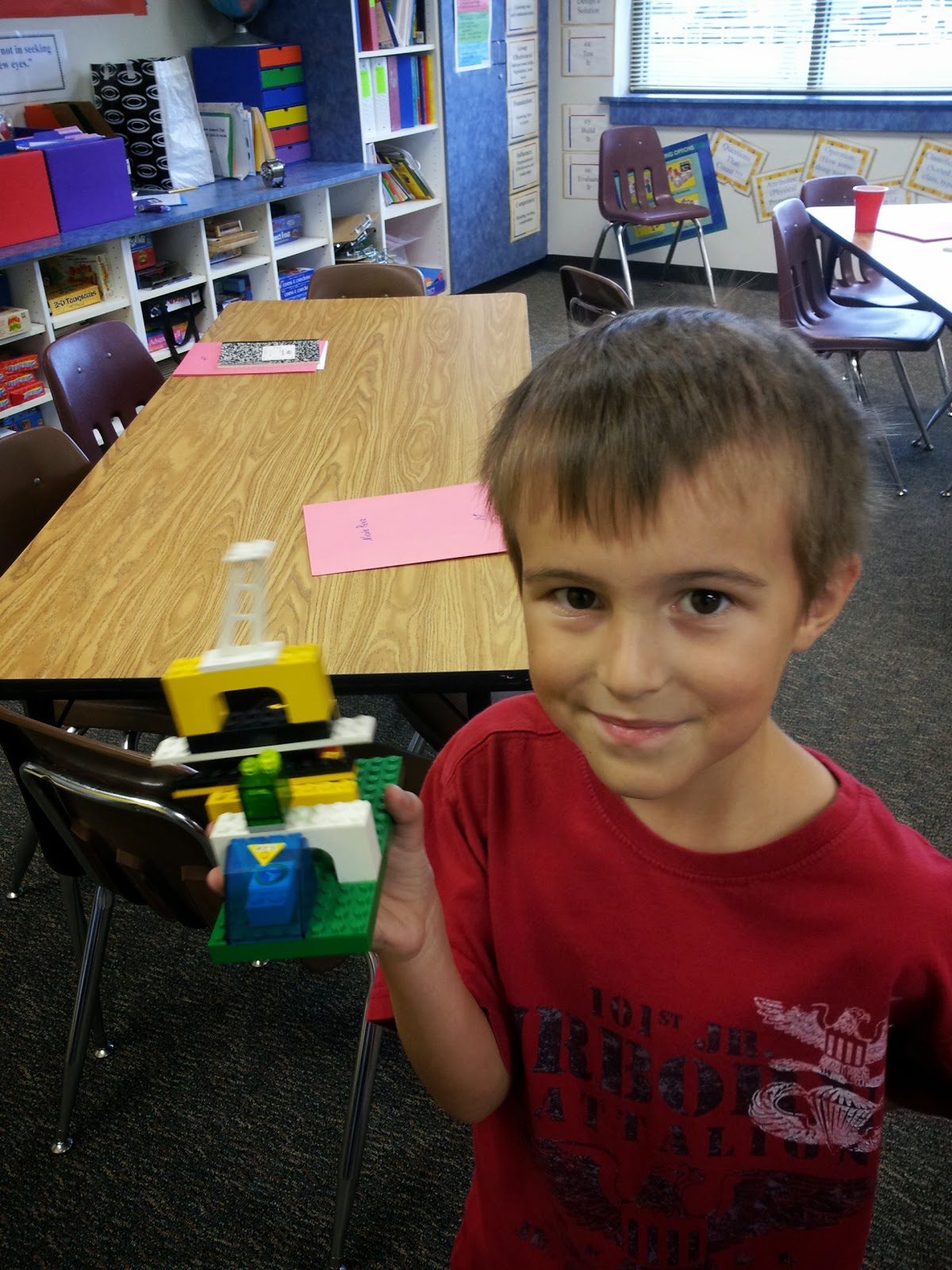
We balanced out the analytical thinking required for our research with a creative challenge: design a light bulb of the future using LEGO pieces!


Next, we applied our growing knowledge of light bulbs by using the classic picture book The Important Book as a model to create our own "important pages" about the light bulb. We also illustrated and diagrammed the major parts of the light bulb to go along with it.


Then it was time to move beyond the light bulb and look at another project that Edison played a role in: the motion picture (AKA the movies!). We discussed the concept of persistence of vision that early animators used to explain how a series of still images could seem to move. Edison was fascinated during his life with one particular, very simple animation device called a thaumatrope. Here's a video with the instructions we used to make our own. The students learned by trial and error which methods worked best and created some very fun, animated scenes! 


Our next step is to take a technological leap but use the same basic methods to create a more complex movie. We'll be using a stop-motion movie maker app on the ipads. Our next update should be some movies for you to watch!


Friday, October 4, 2013

5th Grade: To Boldly Go...

The encounter of civilizations is our driving theme in 5th grade this year. To start generating a list of the attributes of civilizations and also to explore what kinds of consequences arise out of two civilizations encountering each other, we read the book Encounter by Jane Yolen:

Next, to extrapolate this concept of an encounter and put our own current civilization into the story, students created comics that imagined the first contact between modern humans and an "alien civilization." Yes, they have been a lot of fun, but creating them also forced us to reflect on the basic attributes of civilizations (i.e. government, economy, currency, clothing, language, number system, holidays, norms, etc.).

Then we read the story of a boy who was so fed up with his own civilization, who felt so left out and unrecognized, that he literally invented his own from the ground up. Meet Weslandia:


With Weslandia as our inspiration, we've now begun the gradual process of designing our own civilizations. We are starting with Math, or course! OK, it wouldn't have been everyone's choice, but you have to start somewhere. So far, we've studied the number systems of the Babylonians, Egyptians, Romans and Greeks. We'll also study some more modern systems, like binary, before we start creating our own number systems.

4th Grade Update: The "Wright" Stuff

Other grade levels are enjoying novels as a supplement to their units this year, but 4th grade is the only group using a novel as the primary launch pad for all their explorations. The novel is The Wright Three by Blue Balliet. Here's a book talk/preview:

To set a foundation for reading, we first built up some background knowledge on architecture in general, including some basic concepts and a scavenger hunt of some famous buildings. This included a DI-like design challenge where the students had to create skyscrapers out of very limited materials (tape and two types of paper) in a very limited time. They did quite well!

Since the book centers around the Robie House, a work by Frank Lloyd Wright, we then did some background research on Wright, and each week we are building on that knowledge.

Another huge connection from the novel are pentominoes, a set geometrical and mathematical tools with all kinds of uses. We started with 2-D pentominoes and worked our visual-spatial skills with a number of challenges.


One student designed "Texonimo" in honor of the Lone Star state.

 We've since pulled out some 3-D pentominoes and that opens up a whole new set of challenges!

At the same time, the book itself has made us intrigued with The Invisible Man by H.G. Wells. None of us understand the connection yet, but it keeps popping up in the story. This trailer of the old black and white movie sure got our attention, too!


Our most recent challenge that demanded creativity, innovation, cooperation and organization was another design challenge using LEGO bricks. In our "Think Like an Architect" challenge, students were presented with a client (a family of 4) with specific needs in a home. They then had to design the home to meet those needs. We had some wildly innovative samples!


Soon we'll delve into the more technical and mathematical aspects of architecture, but this was a way to understand the creative problem solving with which an architect approaches his or her work.


Friday, September 27, 2013

3rd Grade Update: A Shocking Discovery!

In third grade we have the fortune of studying one of the most fascinating people in American history--Benjamin Franklin. Rather than a traditional biography study, though, we jumped right in with a survey of many of his incredible inventions and how they led to modern manifestations. For example, did you know that Benjamin Franklin invented the first odometer to track the mileage he put on his horse buggy when he was the post man of Philadelphia?

Then we honed in his most iconic discovery and the famous kite experiment. After studying the historical context and relevance of the experiment, we decided to build our own kites! A couple students have already finished. The rest will be finished up next week.
Parents, we will NOT be flying these in a lightning storm!
It was important for students to clarify that Franklin did not "discover" electricity. He proved that lightning was a form of electricity. That allowed him to then think about controlling it in order to protect tall buildings, and that is how the lightning rod was born.


As part of our literature connection, we are also reading the rather revealing alternative history of Benjamin Franklin's life as told by his mouse Amos in the book, Ben and Me by Robert Lawson. Turns out there's more to the story than anyone knew!

2nd Grade Update: Toys as Tools (for learning!)

You can imagine the excitement the first day of class when I announced our topic this year would be toys! What we soon discovered, however, was that there was a lot more to it than simply "playing." First, we used toys as a tool for exploring the power of brainstorming and practiced FFOE creative thinking skills.

Next, we used the book Tomorrow's Alphabet as inspiration to create our own alphabet called Yesterday's Toy Alphabet. Rather than try to explain the logic of the concept, read some of the student entries below and see if you can infer the methodology:

C is for stuffed animal, yesterday’s Cotton. (Vale) 
C is for puzzle, yesterday’s Cardboard. (Regina) 
E is for painting, yesterday’s Empty paper. (Vale) 
F is Nerf bullet, yesterday’s Foam. (Angelo) 
G is for bunny, yesterday’s Glass. (Vale) 
M is for lunchbox, yesterday’s Metal. (Angelo) 
P is for bread, yesterday’s Plastic. (Regina) 
R is for action figure, yesterday’s Rubber. (Vale) 
S is for horsey, yesterday’s Stick. (Angelo)
W is for blocks, yesterday’s Wood. (Crystal) 
W is for car, yesterday’s Wheel. (Vale) 
W is for doll, yesterday’s Wood. (Vale) 
Y is for kite, yesterday's Yarn. (Regina) 
Y is for sweater, yesterday’s Yarn. (Crystal)

There is a tricky combination of logic and creativity that goes into each entry and the students did quite well!

Next, we got out the LEGOs and used them as a tool to discuss attributes and do some sorting. The peak of that challenge was sorting pieces by attribute on a triple Venn diagram!

 Of course it was also fun to end that class period with a collaborative creative problem solving challenge. They had to build a garage for a sports car!

Next week, we begin a research project on the history of LEGO.


1st Grade Update: 8 Kinds of Smart

What does it mean to be "gifted" at something? Does being gifted mean being smart at everything? These are some basic but very important questions we've been answering with some bibliotherapy (using literature as a self-learning tool) the first few weeks of 1st grade GT.

We used a series of wonderful books by the actor John Lithgow. Each book is centered on a character with a special, but specific, type of giftedness. For Farkle McBride it's musical talent. For Macawber it's artistic talent. And for Marsupial Sue it ends up being intrapersonal intelligence.


After reading and enjoying the journeys of these characters, we took our own inventory called "8 Kinds of Smart" based on Howard Gardner's theory of multiple intelligences. After, we completed some reflection questions and graphed the results to get a visual of how our 8 types of smart compared.


Since this was a self-reflection, results may not have been completely accurate. However, the important thing was the process of reflection and the understanding that giftedness comes in many shapes and sizes.

We've now begun our study of inventors by researching the life of Thomas Edison. The challenge level will be high and we'll be looking to push our limits as first grade learners.