FIRST GRADE: Inventions

The inspiration and the perspiration. Let's study Thomas Edison. And then invent ourselves.

SECOND GRADE: Toys and Roller Coasters

Let's dissect and reverse engineer them. Let's design and create them. Let's imagine!

THIRD GRADE: Inventors

They say he wrangled lightning and invented bifocals. And that was just before breakfast. We'll start with Benjamin Franklin and move on to Da Vinci...

FOURTH GRADE: The Wright Three

Architecture, ghosts, pentonimoes, geometry, mysterious talismans, invisible men... One novel has them all.

FIFTH GRADE: Weslandia

What if you were in charge of rebuilding civilization from the ground up? Well now you are...

Showing posts with label LEGO. Show all posts

Wednesday, May 28, 2014

End of Year LEGO Stop-Motion Movies!


Let's face it, when we have two huge bins of LEGO pieces sitting around and access to some cool stop-motion technology, why would we NOT make some awesome stop-motion movies as part of our end-of-year thematic summaries?

But here's the thing: Each grade level was tasked with creating a stop-motion movie that related to our theme for the year. So 5th grade, for example, had to make their film relate to "encounters" between two civilizations or groups; 4th grade's movies had to center around a piece of architecture, and so on...

First we studied some "best practices" for making stop motion with LEGOs, including considering such factors as positioning, background, lighting, movements, etc. Students learned that making a quality stop motion is MUCH harder than they thought, and requires oodles of patience and concentration. That made it an even more important exercise!

At the link below you can access a folder with all the videos. File names are labelled by student first names. Enjoy!

NOTE: We used the app "LEGO Movie Maker" on the iPads. That app is not available on Android but there are other user-friendly stop-motion apps on the Android market.

https://drive.google.com/folderview?id=0B2urbvFV8qF1c3lBaHNYNHNDR0k&usp=sharing


Friday, November 15, 2013

1st Grade Update: Stop Motion Movies

Our research on Thomas Edison led us into the fascinating world of early animation and some of the tools early animators used to create the illusion of movement and hence, "motion pictures." One of these early tools that Edison himself was inspired by was the thaumatrope. In a previous post, you can see that we made our own thaumatropes. 

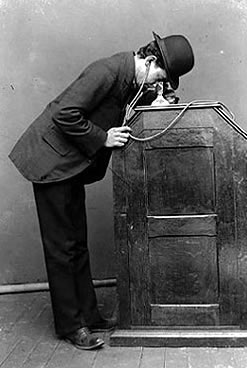
A more advanced early animation and motion picture tool was the kinetescope. It passed a series of still pictures through a view finder and gave the illusion of a movie to those who watched. We learned that the more still pictures (frames) you pass per second, the more smooth and realistic the movie is.

We applied this same concept but with help from a little modern technology. The LEGO Movie app allows you to create stop motion animation in much the same way these early machines did. It was tough to learn from all of our mistakes in just one hour, but I was very impressed with what the students created in such a limited time! Their videos are below:


Monday, November 4, 2013

1st Grade Update: From Light Bulbs to Motion Pictures

Since our opening unit on learning styles and multiple intelligences, we've covered LOTS of ground researching Edison and related inventions. 

We started with some traditional research using the text Thomas Edison and the Light Bulb and gathered our data into a class "big book."
One of our major research questions was to discover what material made the best filament inside the light bulb for it to last the longest. Originally, light bulbs used cotton thread for the filament. You can imagine the problem with that. After experimenting with THOUSANDS of different options, the best material Edison found for a long-lasting bulb was bamboo! Today, tungsten is the most favored material for a filament in a traditional light bulb.

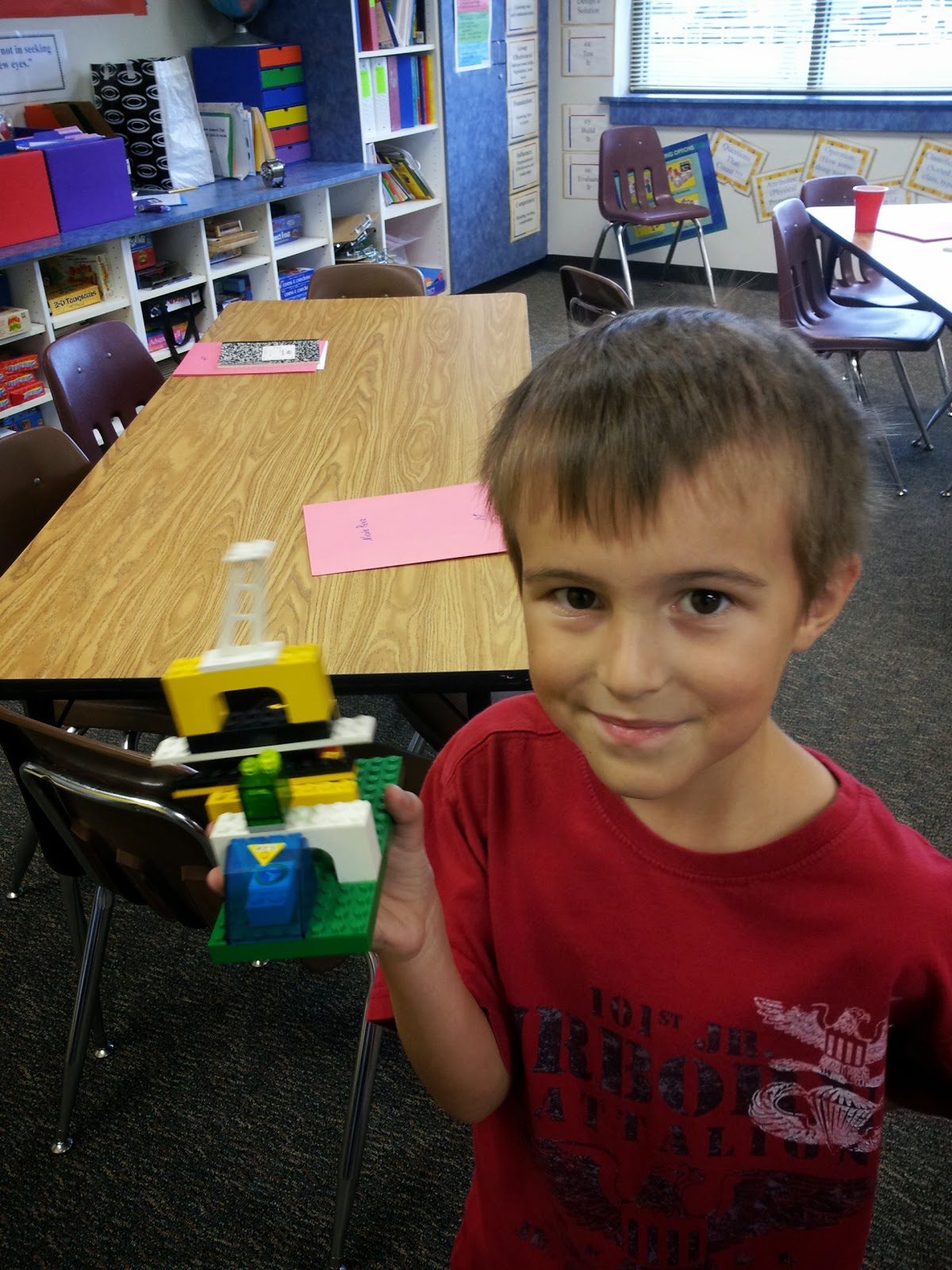
We balanced out the analytical thinking required for our research with a creative challenge: design a light bulb of the future using LEGO pieces!


Next, we applied our growing knowledge of light bulbs by using the classic picture book The Important Book as a model to create our own "important pages" about the light bulb. We also illustrated and diagrammed the major parts of the light bulb to go along with it.


Then it was time to move beyond the light bulb and look at another project that Edison played a role in: the motion picture (AKA the movies!). We discussed the concept of persistence of vision that early animators used to explain how a series of still images could seem to move. Edison was fascinated during his life with one particular, very simple animation device called a thaumatrope. Here's a video with the instructions we used to make our own. The students learned by trial and error which methods worked best and created some very fun, animated scenes! 


Our next step is to take a technological leap but use the same basic methods to create a more complex movie. We'll be using a stop-motion movie maker app on the ipads. Our next update should be some movies for you to watch!


Friday, October 4, 2013

4th Grade Update: The "Wright" Stuff

Other grade levels are enjoying novels as a supplement to their units this year, but 4th grade is the only group using a novel as the primary launch pad for all their explorations. The novel is The Wright Three by Blue Balliet. Here's a book talk/preview:

To set a foundation for reading, we first built up some background knowledge on architecture in general, including some basic concepts and a scavenger hunt of some famous buildings. This included a DI-like design challenge where the students had to create skyscrapers out of very limited materials (tape and two types of paper) in a very limited time. They did quite well!

Since the book centers around the Robie House, a work by Frank Lloyd Wright, we then did some background research on Wright, and each week we are building on that knowledge.

Another huge connection from the novel are pentominoes, a set geometrical and mathematical tools with all kinds of uses. We started with 2-D pentominoes and worked our visual-spatial skills with a number of challenges.


One student designed "Texonimo" in honor of the Lone Star state.

 We've since pulled out some 3-D pentominoes and that opens up a whole new set of challenges!

At the same time, the book itself has made us intrigued with The Invisible Man by H.G. Wells. None of us understand the connection yet, but it keeps popping up in the story. This trailer of the old black and white movie sure got our attention, too!


Our most recent challenge that demanded creativity, innovation, cooperation and organization was another design challenge using LEGO bricks. In our "Think Like an Architect" challenge, students were presented with a client (a family of 4) with specific needs in a home. They then had to design the home to meet those needs. We had some wildly innovative samples!


Soon we'll delve into the more technical and mathematical aspects of architecture, but this was a way to understand the creative problem solving with which an architect approaches his or her work.